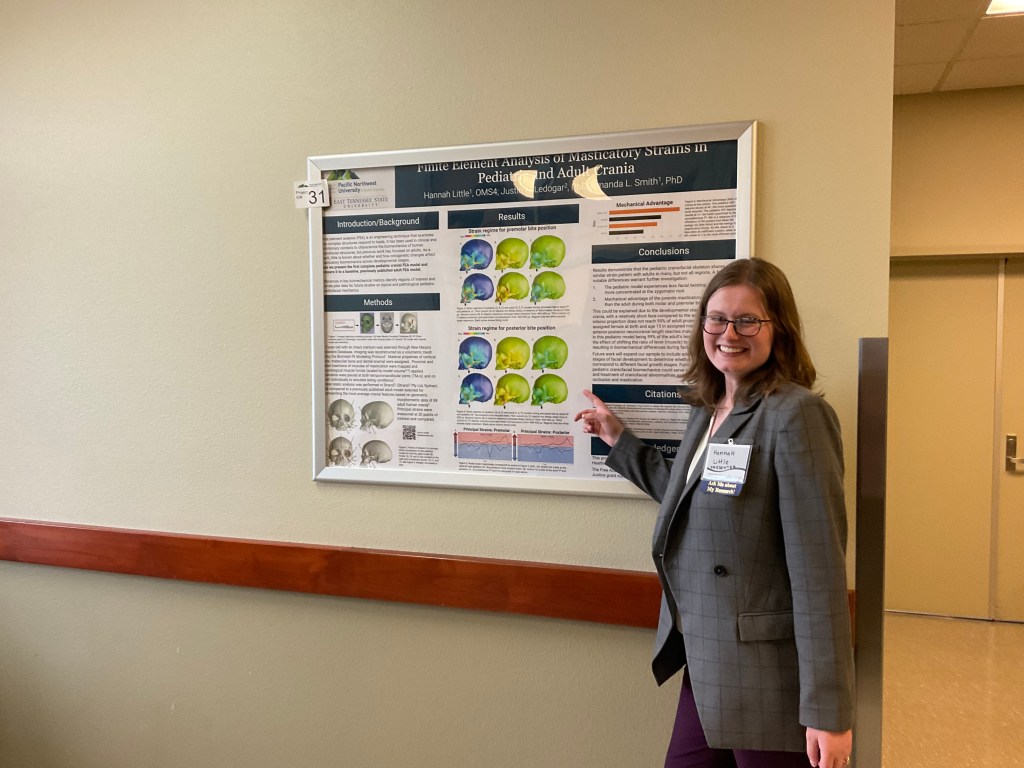
Hannah Little presented her research yesterday:
Finite Element Analysis of Masticatory Strains in Pediatric and Adult Crania.
Hannah won first place for Empirical Research.
Her work is the first to characterize differences between pediatric and adult orofacial biomechanics during chewing.
Her findings will inform future studies on the preservation and restoration of maxillofacial function in children.
Congratulations, Hannah!!!
And let’s hear it for team science!
Rachel Stout, Evangelina Olivera and Gavin Caruso showed off results of their biomechanical modeling of capuchin mandibles. Their work is part of a large multidisciplinary project looking at relationships between dietary ecology, mandibular shape and biomechanical performance.
Mastication in Monkeys: A Biomechanical Analysis of Capuchin Mandibles and Implications for Modern Clinical Care.
If you’re wondering: Why monkeys?
Many of the biomechanical principals we apply to modern dental and maxillofacial care are based on primate models. Experimental in vivo bone strain and kinematic studies have been done with capuchins for many years. Our 3D computer modeling experiments use data generated from these studies to simulate biting in silico.
Because different capuchin species have differently shaped jaws and have diets with different mechanical demands, they’re a great model to use to study form-function relationships.
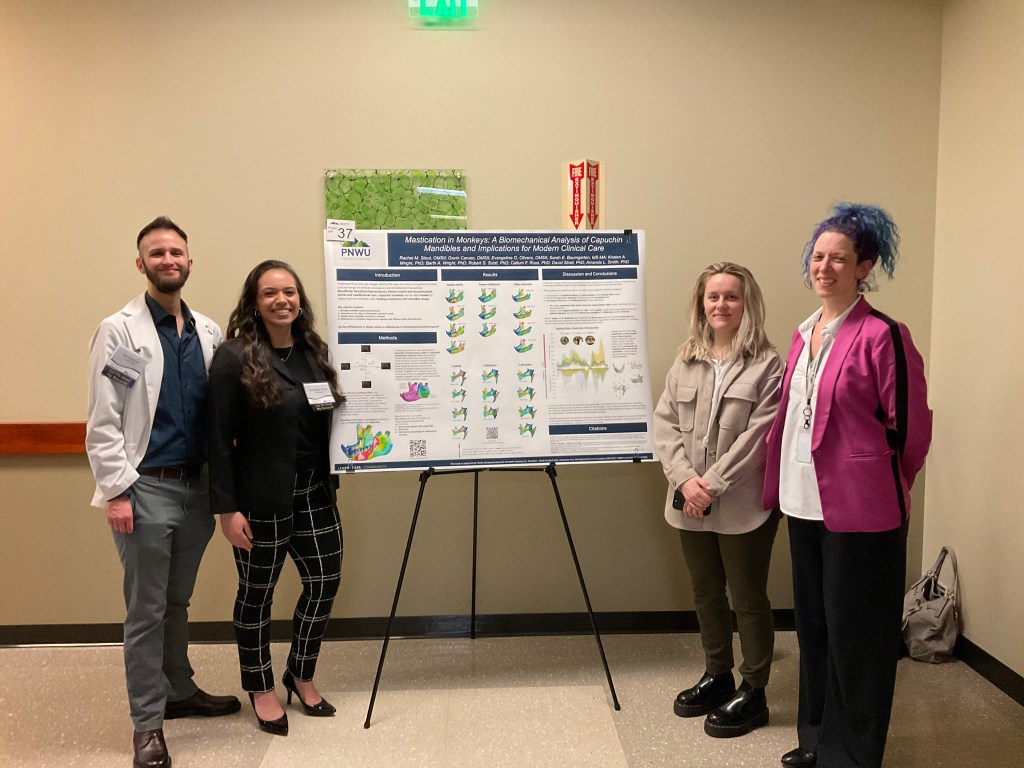
From left, OMS II student researchers: Gavin Caruso, Evangelina Olivera, Rachel Stout, and me.




 Amanda L. Smith